This article is part 2 of a 3-part series. Read part 1, Choosing and understanding an electric pressure washer. You can also review part 3, Troubleshooting an electric pressure washer, in case you need to solve problems while you are using a pressure washer.
You have decided which pressure washer to borrow, made sure the surface you want to pressure wash is safe, checked your outdoor spigot to make sure you have enough water pressure, made sure you have an outlet you can reach, and reserved a pressure washer from the Tacoma Tool Library (TTL).
Keep reading this article to learn how to set up and use the pressure washer.
Safety considerations
Remember, the water sprayed from a pressure washer wand can be dangerous. The water can hurt people or damage surfaces. You should always read the manual and follow the directions to use the tool safely and correctly.
Use personal protective equipment
Water, soap, dirt, small rocks, and other items will spray back when the water hits the surface that you are cleaning. This can hurt you, especially your eyes and any skin that’s not covered.
Always wear:
- Safety glasses or goggles — REQUIRED! View the safety goggles you can borrow from the TTL.
- Closed-toed shoes, not sandals
- Long pants
You may also want to wear gloves, especially if you are using soap or detergent.
Safety rules
- Keep children and pets far away from the pressure washer. If possible, keep them inside the house.
- Never let children play with the pressure washer.
- Never point the wand at people, animals, or yourself, including your feet.
- Never spray the water near or directly on electrical components or power outlets.
- Do not use a pressure washer while standing on a ladder.
- Be prepared for kickback when you pull the trigger.
- If the power cord is plugged into an extension cord, make sure the connection point does not get wet. Put it on top of something a few inches tall, like a brick or board or an upside-down bucket, instead of directly on the ground.
Be aware of your surroundings
- Be careful using a pressure washer near garden beds or delicate plants. The spray can hurt plants. Any substances you are washing off the surface, like oil, grease, or paint might also hurt the plants if they get into the soil.
- Pay attention to where the spray will bounce or ricochet. Keep the spray away from windows or delicate items.
Setting up the pressure washer
Step 1. Understand all parts of the pressure washer and other equipment
- Look for any visible damage to the pressure washer, hose, cord, wand, and other parts.
- Look at the garden hose and make sure it is not cracked or leaking.
- Read the pressure washer manual. Each pressure washer’s manual is linked in the tool’s description in the Tacoma Tool Library catalog.
- Read the safety instructions above, and the rest of the steps in this article.
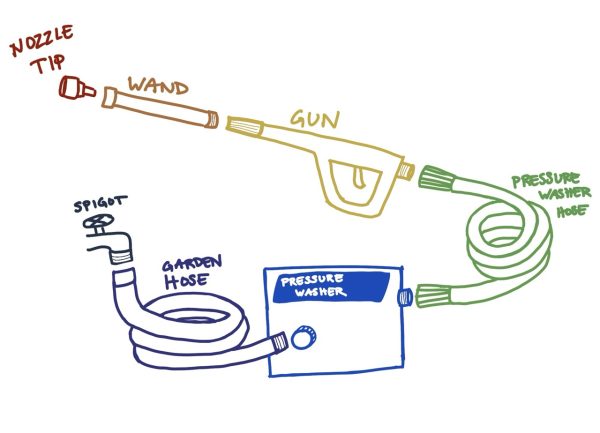 This illustration shows all the parts that you must connect together to use the pressure washer.
Step 2. Connect the water FIRST
Always do this step first, so you don’t forget to do it.
If you turn the pressure washer’s power on when there is no water going into the pressure washer, it can break the pressure washer’s motor.
- Connect the garden hose to the outdoor spigot, if not already done.
- Connect the garden hose to the pressure washer water intake.
- If the water intake filter is dirty, clean it before starting.
- If the water intake filter is damaged, do not use the pressure washer.
- Turn the spigot on all the way.
- DO NOT TURN THE PRESSURE WASHER ON YET.
- Attach the wand to the pressure washer gun. Screw it in by hand. You do not need to use tools to tighten it.
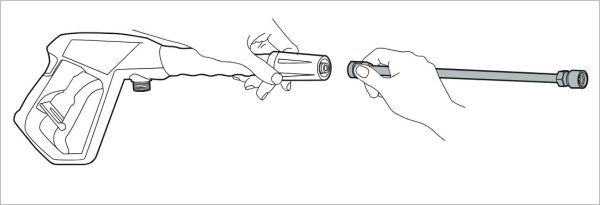 How to attach the spray wand to the pressure washer gun
 - Attach one end of the high-pressure hose to the gun, and the other end to the pressure washer.
- Squeeze the trigger on the pressure washer wand. This will make sure any air comes out of the system. When you do this, water should come out of the end of the pressure washer wand. If no water comes out of the end of the pressure washer wand, then something is wrong. Read the pressure washer’s manual for more information.
- Check all the connection points to make sure all the hoses are securely connected and there are no leaks.
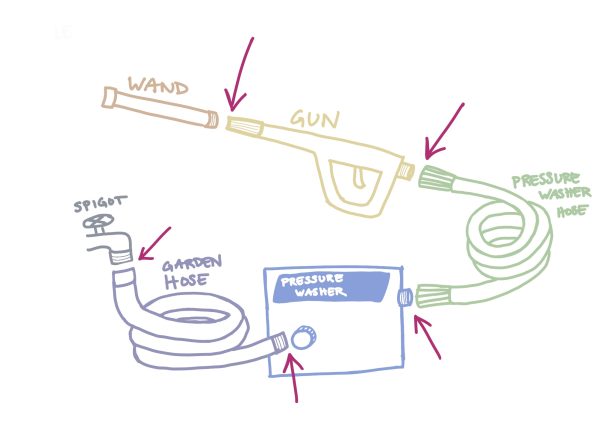 Each arrow indicates a connection point where you should check for leaks before using the pressure washer.
Step 3. Select a spray tip
Each spray tip is a different color and is used for a different purpose. Each spray tip also has a number that shows how wide the water spray will be. A smaller number means the spray will be narrower and more powerful. A larger number means the spray will be wider and more gentle.
You should always start with a wider spray tip, and only move to a narrower spray tip if you need to.
This video explains the different spray tips and what they are used for.
| Color | Size (in degrees) | Spray width | Use for |
|---|---|---|---|
| Red | 0º | Very thin | Most powerful, and most likely to damage the surface or hurt a person. Be very careful when using this spray tip! Some websites recommend not using it at all. |
| Yellow | 15º | Narrow | For hard surfaces like concrete, brick, or stone, and tough stains. |
| Green | 25º | Medium | For general cleaning on most surfaces, including siding and decks. |
| White | 40º | Wide | For vehicles, wood, and other surfaces that can be damaged. You should start with this spray tip unless you are very sure you need one of the others. |
| Black / soap | 65º | Very wide | Only use this to apply soap or detergent. |
Step 4. Insert the spray tip
After you choose a spray tip, attach it to the end of the pressure washer wand.
- Pull back and hold the quick-connect fitting on the end of the wand.
- Insert the spray tip all the way into the end of the wand.
- Let go of the quick-connect fitting.
- Pull on the spray tip to make sure it is securely connected. It should not wiggle or feel loose.
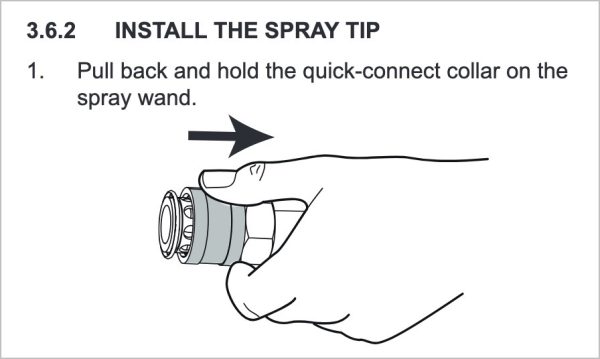 Step 1 to install the spray tip. Step 1 to install the spray tip. |
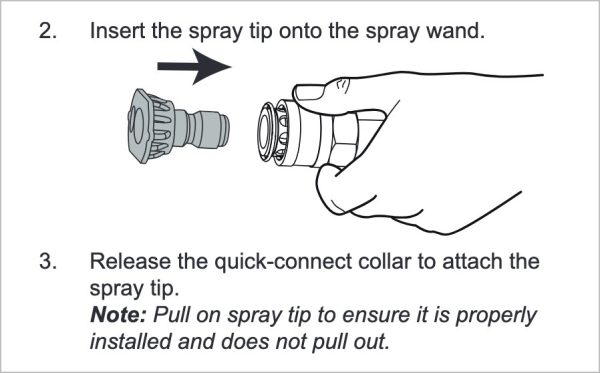 Step 2 to install the spray tip. Step 2 to install the spray tip. |
Step 5. Connect the power cord
- Plug the pressure washer’s power cord into an outlet, or into an extension cord that is plugged into an outlet.
- Make sure the GFCI part of the power cord does not get wet. Put it on something a few inches tall, like a brick or board or an upside-down bucket, instead of directly on the ground.
- If the power cord is plugged into an extension cord, do the same thing for the connection point between the pressure washer cord and the extension cord.
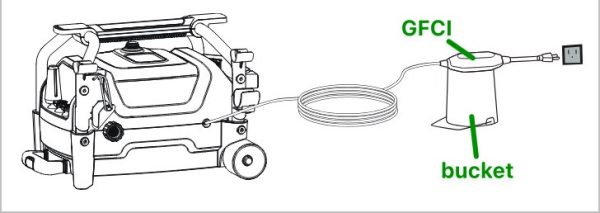 This illustration shows how to ensure that the GFCI does not fall into a puddle of water.
- If the power cord is plugged into an extension cord, do the same thing for the connection point between the pressure washer cord and the extension cord.
- Make sure that the connection point won’t get wet from water spray when you use the pressure washer.
Using the electric pressure washer
Starting up: follow steps in this order!
- Check again to make sure that water is flowing all the way through the pressure washer:
- DO NOT TURN THE PRESSURE WASHER ON YET.
- Squeeze the trigger on the pressure washer wand. Some water should come out of the end of the pressure washer wand.
- If water does not come out of the end of the pressure washer wand, consult the pressure washer’s manual.
- Make sure that your chosen spray tip is securely inserted.
- Point the spray gun in a safe direction. A test surface is best. Never point it at another person or animal, or at yourself, including your feet.
- Turn on (start) the pressure washer. Each type of pressure washer has a different way to turn on. It might be a button, a switch, or a dial.
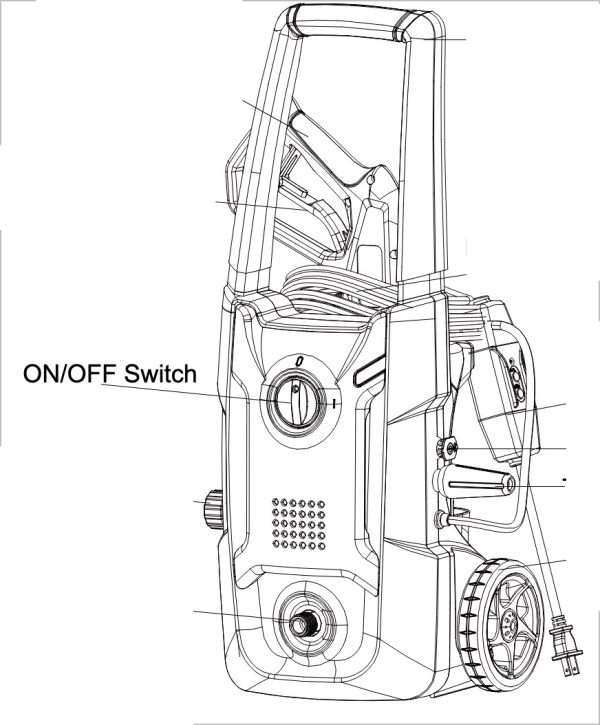 How to turn on the Greenworks 1600 PSI model
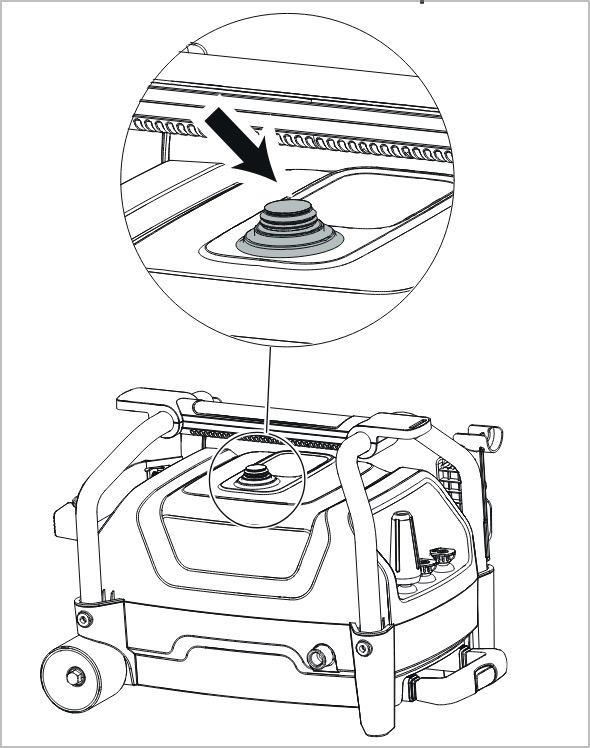 How to turn on the Greenworks 2100 PSI model
 - Keep pointing the wand in a safe direction at your test surface. Pull the trigger on the pressure washer wand. Be prepared for some kickback when the pressurized water starts to flow.
- Use it on the test surface for a few minutes to understand how it works.
- The water spray will act differently depending on the distance between the end of the wand and the surface, and the angle of the spray of the water.
- Practice your technique so you understand what happens when you do different movements.
Proper technique for effective cleaning
Distance between wand and surface
Start with the end of the wand about 2 or 3 feet away from the surface.
Angle of water spray
Hold the wand at about a 45º angle to the surface.
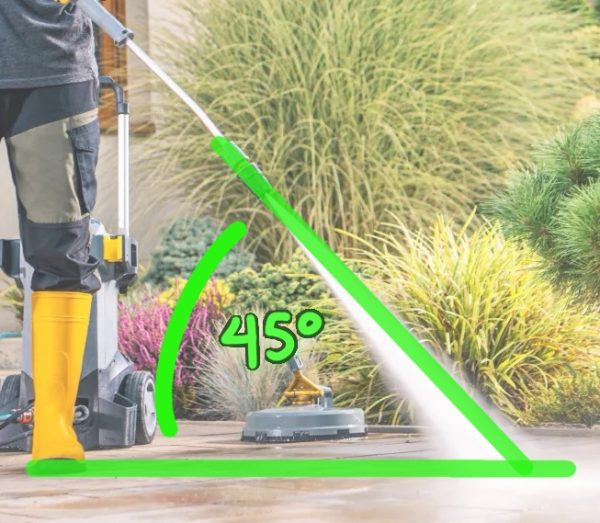 Keep the pressure washer’s spray angle at about 45º from the surface you are washing.
Image from iWash Pressure Washing.
Moving the wand
- Always keep the wand moving. If you hold it in one place, you might damage the surface.
- Start at the top of your surface and work downwards.
- Use a smooth, steady sweeping motion, and overlap each pass.
If it’s not cleaning as well as you want
The surface might not get as clean as you want it to be. Try these steps, in this order:
- First, try moving the end of the wand closer to the surface.
- If that doesn’t work, try a different angle of spray.
- If it is still not working, turn the power off and switch to a narrower spray tip.
Using soap
You might want to use soap or detergent on the surface you are cleaning. You can borrow a soap applicator from the Tacoma Tool Library.
To use a soap applicator:
- Fill the applicator with pressure washer soap. Do not use dish soap or any other household soap.
- Attach the applicator to the end of the pressure washer wand, instead of a spray tip. The applicator includes the 65º soap application spray tip.
- Follow the directions above for setting up and turning on the pressure washer.
- Use the same techniques described above, including moving the wand from top to bottom in a smooth sweeping motion.
- Follow the soap manufacturer’s directions for letting the soap rest.
- Take off the soap applicator and put on the white (45º) or green (20º) spray tip. Follow the directions above to switch the spray tips.
- Using the same sweeping motion from top to bottom, rinse off the soap.
- Rinse again from top to bottom if needed.
Pay attention to the pressure washer while you are using it
If it isn’t working correctly, or if you don’t use it correctly, the pressure washer can be damaged or broken. Make sure you pay attention to how it is working while you are using it.
While you are using it:
- The water spigot should always be on.
- All hose connection points should always be secure with no leaks.
- The water pressure coming out of the wand should not change. It should be the same water pressure every time you pull the trigger.
DO NOT leave the motor running without also using the wand (pulling the trigger so that water comes out). If you want to stop using the wand for more than one or two minutes, turn off the pressure washer’s motor.
When the motor is still running but the water is not being used, the water inside gets hot. The hot water can damage the machine.
Stop using the pressure washer immediately if:
- The extension cord connection point, or the outlet where the cord is plugged in, are wet.
- The power cord is hot when you touch it.
- The pressure washer motor makes any unusual noises.
- The pressure washer is hot when you touch it.
- You smell burning or other odors, or you see steam or smoke.
- The pressure washer shuts itself off.
If any of these things happen, you must:
- Let go of the trigger
- Turn off the pressure washer using power switch, button, or dial
- Unplug the pressure washer from the outlet or the extension cord.
When you are done using the pressure washer
Shutting down: follow steps in this order!
- Turn off the pressure washer and unplug it.
- Make sure the ends of the power cord and extension cord do not get wet.
- Turn off the water spigot.
- Take the spray tip off the end of the wand.
- Squeeze the trigger until water stops coming out. There is no pressure anymore, so it will not come out very fast.
- Disconnect the garden hose from the pressure washer.
Preparing to return it
When you bring the pressure washer back to the Tacoma Tool Library:
- Drain any water out of the hose and wand.
- Coil or wrap the hose. If there are any straps or hooks on the pressure washer, use them to fasten the hose.
- Coil or wrap the power cable.
- Make sure you are returning all the pieces of the pressure washer. If you’re not sure, you can look up your chosen pressure washer by its five-digit ID number in the TTL catalog to see pictures and a list of the pieces it should have.
Next steps
Ready to borrow a pressure washer from the Tacoma Tool Library? Review the first article in this series, Choosing and understanding an electric pressure washer, to make sure you know what you’re getting, to get advice on which of our pressure washers to choose, and to learn about other equipment you need to use it.
Then go to the Tacoma Tool Library’s catalog to reserve a pressure washer and any other supplies you need. When you pick it up, you will need to read and agree to our pressure washer training. You can review that training ahead of time.
If you’re not a member of the Tacoma Tool Library yet, start by creating your membership.
No AI/LLM was used to write this article. A real person wrote it!

Tacoma Tool Library is funded by WA State Department of Ecology with funding from Washington’s Climate Commitment Act. The CCA supports Washington’s climate action efforts by putting cap-and-invest dollars to work reducing climate pollution, creating jobs, and improving public health. Information about the CCA is available at www.climate.wa.gov.