This article is part 1 of a 3-part series. Read part 2, Using the Tacoma Tool Library’s electric pressure washers. You can also review part 3, Troubleshooting an electric pressure washer, in case you need to solve problems while you are using a pressure washer.
What is a pressure washer?
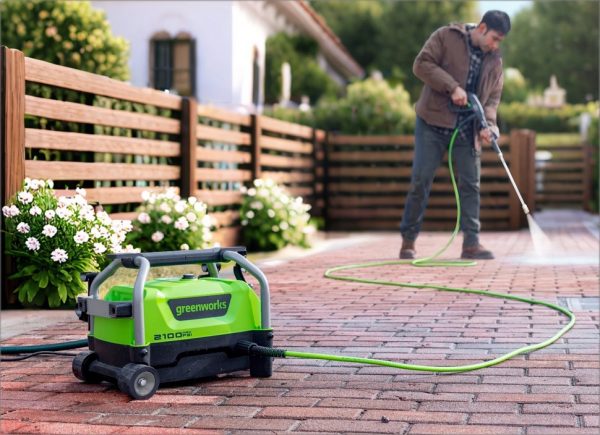
A pressure washer is a machine that pressurizes water so that you can spray it with a lot of force. It has a wand with a trigger. When you pull the trigger, the water sprays out from the end of the wand in a strong jet. This high-pressure water can remove mud, dirt, mold, moss, loose paint, and other debris. You can use it to clean your house or other buildings, including siding, windows, gutters, patios, brick, stone, sidewalks, and other concrete surfaces. If you are careful and use the right spray tip, you can also use it to clean cars, boats, other vehicles, and other items including outdoor furniture.
You can use different spray tips to change how strong the water pressure is when it comes out of the wand. Make sure you use the right spray tip for the project you are working on. Read more about spray tips in our second article in this series. The water pressure is measured in pounds per square inch (PSI). A higher number means the water pressure is higher, and the spray is stronger.
Because the water pressure is very high, the water sprayed from the wand can be dangerous. The water spray can hurt people or damage surfaces.
Pressure washers are easy to break if you do not use them correctly. You should always read the manual and follow the directions for how to use the tool safely and correctly.
What pressure washers can and can’t do
When you use a pressure washer, the water spray might damage the surface you are trying to wash. The water can chip the paint or finish, or cause it to flake or peel. It can also cut into, etch, or dent the item itself.
Before you start:
- Always test the pressure washer on a small or hidden part of your surface first.
- Stand farther away from your surface when you start, and use a wider spray pattern. Then you can get closer or use a narrower spray pattern if you need to. Read more about spray tips in the second article in this series.
DO NOT use a pressure washer on:
- Gravel or other loose material. The water will make rocks fly up and can hurt you or other people, or damage nearby items.
- Asphalt shingles on roof or shingled siding.
- You can damage the shingles, or make them fall off.
- The pressurized water can get under the shingles and cause damage to the structure of the house underneath.
- Any surface that was painted before 1978. Surfaces, especially houses, that were painted before 1978 might have lead paint. Using a pressure washer can chip paint and create lead dust, which is a serious health hazard. If the surface you want to pressure wash has old paint, get it tested before pressure washing painted surfaces. For more information about lead paint, visit the Environmental Protection Agency (EPA)’s lead safety page.
- Light fixtures, electric meters, solar panels, generators, air conditioners, or anything else with an electrical part — even if the item is designed to be used outdoors. The high-pressure water is different from being outside in the rain. The high-pressure water can get inside the item and damage the electronics.
- Delicate surfaces like stucco, soft wood, or old brick. The high-pressure water can cut, etch, or damage the surface.
- Windows or glass at close range. The water can crack or break the glass or push it out of its frame.
- Living things like plants, pets, or people. The high-pressure water can hurt or cut living things!
Safe to use a pressure washer on:
- Driveways and other concrete surfaces
- Hardscaping like pavers, flagstones, brick, and stone
- Vinyl siding or fiber cement siding
- Wood siding, unless it was painted before 1978 (see above)
Use caution with:
- Wood decks, fences, and other structures. Different kinds of wood are softer or harder. The water pressure can damage some kinds of wood.
- Aluminum siding. The water pressure might dent the siding.
- Cars, vehicles, and boats. The water pressure might damage the paint.
- Outdoor furniture, play structures, barbecues, fire pits, etc. The water pressure might damage the item or the paint.
- The metal parts of wheelbarrows, shovels, rakes, and other garden equipment. The water pressure might damage painted surfaces or wood handles of garden equipment.
Check before you use a pressure washer on:
- Composite decks, fences and other structures, such as Trex. Check the warranty of the composite material to make sure you won’t void the warranty if you use a pressure washer.
Electric vs gasoline pressure washers
All the Tacoma Tool Library’s pressure washers are electric. They plug in to an electrical outlet. They do not use gasoline.
Electric pressure washers work well for most things you need to do at home and in the yard. But it is important to understand the differences and to make sure you are choosing the right tool for the job you need to do.
Power and cleaning ability
Electric pressure washers are less powerful than gas pressure washers. Gas pressure washers usually have a PSI (water pressure) of over 3000, and often over 4000. Electric pressure washers usually have a PSI of under 3000, and often under 2000. Lower PSI means the water pressure isn’t as strong.
Because gas pressure washers are more powerful, they can clean an area faster than an electric one. Gas pressure washers can also be used to remove stains on some surfaces and old paint. Electric pressure washers are not usually powerful enough to do those jobs.
The Tacoma Tool Library’s electric pressure washers are between 1600 and 2100 PSI. They work well for routine cleaning of decks, driveways, siding, outdoor furniture, and vehicles. They are not designed for heavy-duty jobs like removing deep stains on concrete or stripping paint.
When you can use them
Electric pressure washers must be plugged in. If you need to clean an area that doesn’t have electricity nearby, you will not be able to use an electric pressure washer.
Electric pressure washers can be used in enclosed spaces. Gas pressure washers give off carbon monoxide, which can make you sick or even kill you if you breathe it in. You must always use a gas pressure washer or any other gas-powered item OUTSIDE, never inside or in an enclosed space. But electric pressure washers do not give off carbon monoxide, so it is safe to use them in enclosed areas like inside a garage.
Safety and ease of use
Electric pressure washers are generally safer and easier to use. They are easy to start just by pushing a button or turning a switch. They have lower PSI, so the water pressure isn’t as strong. This means that electric pressure washers are easier to control. You are also less likely to accidentally damage the surface you are cleaning.
You still need to be careful and follow directions when using ANY type of pressure washer!
To read more about gas vs electric pressure washers, read this article on BobVila.com: Electric vs. Gas Pressure Washer: Choosing the Right Cleaning Machine.
Choosing which of the TTL’s pressure washers to use
The Tacoma Tool Library (TTL) has several kinds of pressure washers. They are different brands, have different PSIs, and work in different ways. For details about any of the TTL’s pressure washers, look up your chosen pressure washer by its five-digit ID number in the TTL catalog to find a link to its manual. You can also read more about our Greenworks pressure washers, purchased new in Autumn 2025, in our second article.
When choosing which one to use, you should think about:
- What kind of surface you want to clean
- How dirty or stained the surface is
- Your experience or comfort level with using a pressure washer
Light-duty pressure washers (up to 1800 PSI)
Because it has a lower PSI, the water pressure will not be as strong. This means it is less likely to damage the surface you are washing, so you can use it on more delicate surfaces. But it also means it will not be strong enough to clean some dirt or stains, and it will take longer to clean large areas.
If you are worried about damaging the surface you are cleaning, or you are not very comfortable using a pressure washer, you can start with a light-duty PSI pressure washer, like the 1600 PSI pressure washers.
Medium-duty pressure washers (1900 PSI and higher)
A medium-duty pressure washer has more water pressure. This means it can clean faster, and can clean dirt or stains that the other kind can’t clean. But it also means you need to be more careful when using it, because you might damage your surface with the higher water pressure.
If you are comfortable using a pressure washer, and you have a larger or a very dirty or stained area to clean, and the surface is not delicate, a medium-duty pressure washer, like our 2100 PSI pressure washers, is a good choice.
Safety considerations
Remember, the water sprayed from a pressure washer wand can be dangerous. The water can hurt people or damage surfaces. You should always read the manual and follow the directions to use the tool safely and correctly.
Use personal protective equipment
Water, soap, dirt, small rocks, and other items will spray back when the water hits the surface that you are cleaning. This can hurt you, especially your eyes and any skin that’s not covered.
Always wear:
- Safety glasses or goggles — REQUIRED! View the safety goggles you can borrow from the TTL.
- Closed-toed shoes, not sandals
- Long pants
You may also want to wear gloves, especially if you are using soap or detergent.
Safety rules
- Keep children and pets far away from the pressure washer. If possible, keep them inside the house.
- Never let children play with the pressure washer.
- Never point the wand at people, animals, or yourself, including your feet.
- Never spray the water near or directly on electrical components or power outlets.
- Do not use a pressure washer while standing on a ladder.
- Be prepared for kickback (the water making the wand push back towards you) when you pull the trigger.
- If the power cord is plugged into an extension cord, make sure the connection point does not get wet. Put it on top of something a few inches tall, like a brick or board or an upside-down bucket, instead of directly on the ground.
Be aware of your surroundings
- Be careful using a pressure washer near garden beds or delicate plants. The spray can hurt plants. Any substances you are washing off the surface, like oil, grease, or paint might also hurt the plants if they get into the soil.
- Pay attention to where the spray will bounce or ricochet. Keep the spray away from windows or delicate items.
What you need to get started
Required equipment
- Personal protective equipment, mentioned above
- Outdoor water spigot with good water pressure
- The pressure washers need 1.2 gallons per minute (GPM) of water going into them. Most household faucets and spigots have this much water.
- If your faucet’s water pressure is low, or if you’re not sure, use this calculator to find out your GPM.
- A garden hose to connect your spigot to the pressure washer. View the garden hoses you can borrow from the TTL.
- An electrical outlet. If you can, you should use an outlet with GFCI protection, which stops the electricity if water causes an electrical short. But the pressure washer has a GFCI on the cord also.
- An extension cord, if you need to move the pressure washer farther than 35 feet from an outlet. View the extension cords you can borrow from the TTL.
- Whichever pressure washer you decided to use. View the pressure washers you can borrow from the TTL.
- A set of spray tips for the pressure washer. These are not included when you borrow a pressure washer; you must borrow them separately. View the pressure washer spray tip sets you can borrow from the TTL.
Optional equipment
- Pressure washer soap or detergent.
- Do not use dish soap or any other household soap!
- The Tacoma Tool Library does not provide pressure washer soap.
- A pressure washer soap applicator. View the soap applicators you can borrow from the TTL.
- Buckets for mixing soap or solutions, or for pre-soaking an item. View the buckets you can borrow buckets from the TTL.
- A scrub brush for pre-treating stains. View the brushes you can borrow from the TTL.
- Drop cloths or plastic sheeting to protect nearby items that can’t be moved.
- Blocks, boards, or some other item to elevate the extension cord connection.
Next steps
You decided which pressure washer to borrow, made sure the surface you want to pressure wash is safe, checked your outdoor spigot to make sure you have enough water pressure, and made sure you have an outlet you can reach.
If you’re not a member of the Tacoma Tool Library yet, start by creating your membership.
Now you can go to the Tacoma Tool Library’s catalog to reserve a pressure washer and any other supplies you need. When you pick it up, you will need to read and agree to our pressure washer training. You can review that training ahead of time.
While you wait, read the second article in this series, Using the Tacoma Tool Library’s electric pressure washers, to get a step-by-step guide to setting up, use, and troubleshooting the pressure washer.
No AI/LLM was used to write this article. A real person wrote it!
Sources
- 1600 PSI 1.2 GPM Electric Wheeled Pressure Washer. GreenworksTools.com. No date; accessed November 12, 2025.
- 2100 PSI 1.2 GPM Portable Cold Water Electric Pressure Washer. GreenworksTools.com. No date; accessed November 12, 2025.
- Which Surfaces Can Be Pressure-Washed? ConsumerReports.org. Updated Updated March 19, 2025; accessed November 12, 2025.
- How to Choose a Pressure Washer. ConsumerReports.org. Updated September 9, 2025; accessed November 12, 2025.
- Electric vs Gas Pressure Washer: Choosing the Right Cleaning Machine. BobVila.com. Updated November 29, 2021; accessed November 12, 2025.
- Pressure Washer Buying Guide. HomeDepot.com. Updated March 6, 2025; accessed November 13, 2025.
- Pressure washing. Wikipedia.org. Accessed November 13, 2025.
- The Difference Between Power Washing vs Pressure Washing. ShackShine.com. Updated May 25, 2017; accessed November 13, 2025.
- A Full Guide to Car Pressure Washing. FamilyHandyman.com. Updated October 30, 2025; accessed November 13, 2025.
- How To Pressure Wash A Car The Right Way. TurtleWax.com. No date; accessed November 13, 2025.
- Keys to Preventing Heat Buildup in High-Pressure Pumps. Pumptec.com. Updated April 23, 2017; accessed November 15, 2025.
Tacoma Tool Library is funded by WA State Department of Ecology with funding from Washington’s Climate Commitment Act. The CCA supports Washington’s climate action efforts by putting cap-and-invest dollars to work reducing climate pollution, creating jobs, and improving public health. Information about the CCA is available at www.climate.wa.gov.