This article is part 1 of a series. Read part 2, About the TTL’s Greenworks electric cultivators.
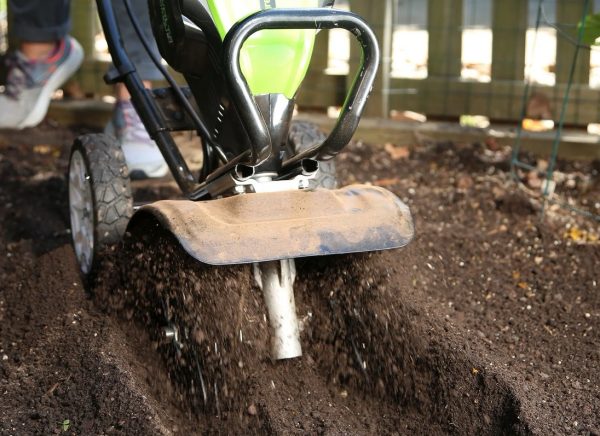
Cultivators are used to loosen and turn over the soil. You can use a cultivator to aerate and prepare the soil before planting, and to mix in compost and other amendments. You can also use them for weeding after your plants are growing: if you carefully use the cultivator between your plants, it will pull up and/or bury the weeds.
Electric cultivators use batteries or plug in to an extension cord. They do not use gasoline. To start an electric cultivator, you push a button or a switch.
Deciding to use a cultivator
A cultivator is not the same as a rototiller
Rototillers are heavy-duty tools. They weigh more, they have a stronger motor, and they usually run on gas. They can be used for breaking new ground to create a new garden bed.
Electric cultivators are lighter. This means they are easier to use, but it also means they can’t break up sod or heavy soil. They are better for working in existing garden beds, not for creating new ones. BobVila.com says “Think of [a cultivator] as a hoe with a motor.”
Use an electric cultivator if you need to:
- Aerate the soil and break up clumps in a garden bed that has been tilled or cultivated before
- Mix compost, fertilizer, or other amendments into the soil
- Weed a garden bed after your plants are growing
Do not use an electric cultivator if you need to:
- Create a new garden bed in hard soil, sod, or grass lawn that has never been tilled or cultivated before
- Till deeper than 8 inches or wider than 16 inches
- Use implements that require a power takeoff (PTO): cultivators do not have a PTO
- Work in an area that is very far from a power outlet, because you need to plug the cultivator in to be able to use it
Some electric cultivators use an extension cord
The electric cultivators that you can borrow from the Tacoma Tool Library use an extension cord, not a battery. If you need to use a cultivator in a location that is very far from an outlet, you will need a long extension cord. Always use an outdoor extension cord. If you use an extension cord that isn’t powerful enough, the cultivator will not work very well, and it might overheat and damage the cultivator.
You need to pay attention to the cord when you use the cultivator. If you run over the cord, the cultivator’s tines will cut it.
Before you start
You should always read the manual before you use a new tool. If you borrowed a cultivator from the Tacoma Tool Library, you can look it up on our tool catalog to find a link to the manual for that cultivator.
Safety
- Use eye protection such as safety glasses when using the electric cultivator. It can kick up rocks or other items in the soil, and injure your eyes.
- Other people must be at least 15 feet away from the tool when you are using it. Other people can also be injured by rocks or other items in the soil.
- Keep children and pets far away from the tool when you are using it.
- Wear closed-toed shoes, not sandals.
- Make sure the cord and plug are not damaged or wet.
Always read the manual of your cultivator for more information!
Setting up the electric cultivator
On some cultivators, you can adjust the depth and width of the cultivator to change how wide or deep it will dig. Read your cultivator’s manual to learn how to do it.
Make sure the cultivator is unplugged or that the battery is removed and that the power switch is off before you adjust it. When you adjust the cultivator, you will be touching the tines. If the cultivator is plugged in when you adjust it, there might be an accident that causes an injury.
If you are using one of the Tacoma Tool Library’s Greenworks electric cultivators, read part 2 in this series, “Using the TTL’s Greenworks electric cultivators.”
Using an electric cultivator
- If you adjusted the depth or height of the cultivator, make sure your adjustments are secure.
- Put on safety glasses, and make sure other people are at least 15 feet away.
- Plug in the cultivator or insert the battery.
- Set the cultivator on the ground where you want to start digging.
- Turn on the cultivator. The tines will start turning.
- Tilt the cultivator forward so the tines dig into the ground, and start pushing the cultivator forward. Go slowly until you learn how it works.
- Walk forward and push the cultivator forward until you get to the end of the area you want to dig.
In this video by DIYwithWayne, the chapters called “Tilling” and “Demo” show you to use an electric cultivator.
Tips for using the cultivator
- You might not be able to dig as deeply as you want the first time you use the cultivator in an area. You may need to use the cultivator more than one time in the same area. Don’t try to dig very deeply on the first try, especially if it isn’t easy to do.
- If the cultivator jumps, try moving a little bit faster.
- If the cultivator gets stuck and stays in one place, try rocking it from side to side.
- If the soil is very hard, you should water the soil, wait one or two days, and then use the cultivator.
- Don’t use the cultivator if the soil is very wet. It is bad for the soil and also can damage the cultivator. If it rains, you should wait one or two days before you use the cultivator.
If you are having problems using the cultivator
| Problem | Possible cause | Solution |
|---|---|---|
| The motor doesn’t start. | The power cord is not plugged in, or is not plugged in all the way. | Plug in the power cord. |
| The circuit breaker is tripped. | Check circuit breaker. | |
| The cultivator smokes while you’re using it. | The cultivator is damaged. | 1. Immediately stop using the cultivator. 2. Unplug the cultivator. 3. Return it to the Tacoma Tool Library and tell us what happened. |
| The motor works, but the tines don’t move. | The cultivator is damaged. | Don’t use it. Return it to the Tacoma Tool Library and tell us what happened. |
| The tines are blocked. | 1. Unplug the cultivator. 2. Remove the item(s) blocking the tines. |
Borrow the TTL cultivators
To borrow a cultivator from the Tacoma Tool Library, go to our library catalog to place a reservation.
If you’re not a member of the Tacoma Tool Library yet, start by creating your membership.
Sources
- Cultivator vs. Tiller: Which Is Best for Your Garden? BobVila.com. Updated Oct 23, 2021; accessed July 22, 2025.
- Dig In: A Cultivator vs Tiller for the Garden. Lowes.com. Updated February 13, 2024; accessed July 22, 2025.
- DIYwithWayne, YouTube.
No AI/LLM was used to write this article.

Tacoma Tool Library is funded by WA State Department of Ecology with funding from Washington’s Climate Commitment Act. The CCA supports Washington’s climate action efforts by putting cap-and-invest dollars to work reducing climate pollution, creating jobs, and improving public health. Information about the CCA is available at www.climate.wa.gov.