This article is part 2 of a series.
In our previous article, Understanding electric chain saws and pole saws, you learned how to decide whether you need a chain saw or a pole saw, and how to prepare your area and other safety tips.
Keep reading this article to review the safety precautions and to learn how to set up and use an electric chain saw or pole saw.
Safety
Remember, chain saws and pole saws are dangerous tools. You should always read the manual and follow the directions to use them safely and correctly.
Use personal protective equipment (PPE)
Always wear:
- Safety glasses or goggles — REQUIRED! View the safety goggles you can borrow from the TTL.
- Closed-toed shoes, not sandals — REQUIRED!
- Long pants made of a thick material.
- Hearing protection, like ear muffs. View the hearing protection you can borrow from the TTL.
You should also wear non-slip gloves and long-sleeved shirts to protect your hands and arms from splinters and flying debris.
Safety rules
- Keep all parts of your body away from the chain and bar while you are using the saw.
- Before you start the saw, make sure nothing is touching the chain and the bar.
- Keep children and pets far away from the saw and from the area where you are working. If possible, keep them inside the house.
- Never let children play with the saw.
- Make sure the saw can’t start accidentally:
- Make sure that the power switch is in the OFF position before you pick up the saw and before you plug it in to the extension cord or put the battery in.
- Remove the battery or unplug the extension cord when you are done working, before you carry or move the saw. Never carry the saw with the battery inserted.
- When you carry the saw, do not put your fingers near the trigger.
- Make sure the place where the saw is plugged into the extension cord does not get wet. Put it on top of something a few inches tall, like a brick or board or an upside-down bucket, instead of directly on the ground.
- Never operate a chain saw while standing on a ladder.
- Make sure your footing is stable.
- Make sure you are standing in a place where you can cut the wood without reaching or stretching too far.
- When using a chain saw, never try to make cuts above your shoulder height.
- When using a pole saw, never cut branches that are near or above power lines. If branches or debris fall on the power lines, it can cause a power outage or injure you.
- When using a pole saw, do not let anyone enter the work area under the tree or branch you are cutting.
- Avoid kickback. Kickback is when the saw moves backwards suddenly, towards your body. This is very dangerous and can cause serious injury.
- The tip of the bar is called the “kickback zone.” Kickback can happen if the tip of the bar touches or hits an object while the saw is running (rotational kickback), or if the tip of the bar gets pinched in the cut while the saw is running (linear kickback).
- Always read your saw’s manual for more information and safety tips.
Getting ready to work
These simple steps will help you stay safe while using a chain saw or pole saw.
Examine and prepare the wood
Before you start cutting, examine the wood.
Remove any metal
Look for any metal in the wood, like nails, screws, staples, or wire. If you hit metal with the saw, it could damage or break the chain. This could cause flying debris that could hurt you or any other people standing nearby. It could also cause the saw to kick back. Kickback is when the saw moves backwards suddenly, towards your body. Kickback is very dangerous.
Wood that has already been used to build something, like old fence wood, pallets, or other construction lumber, probably has metal in it.
Remove any metal before you cut. If you can’t remove it, do not use that wood. Cutting wood with metal in it will damage the saw and might hurt you.
If you accidentally cut into metal that you didn’t know was there, stop using the saw immediately. The chain is probably damaged. Bring the saw back to the Tacoma Tool Library and tell the librarians what happened so we can fix it.
Look for large knots in the wood
A knot grows in the wood where a branch comes out of the main trunk of a tree. The wood in a knot is much harder than the rest of the wood. If you cut through a large knot, the saw can bind (get stuck) or kick back (make the saw move backwards suddenly, towards your body). Both of these situations can be dangerous.
If the saw gets stuck or slows down when it hits a knot, stop. Cut around the knot instead. This is true for all types of wood.
Lumber from a store often has small knots, but these are not usually a problem. In lumber, knots look like circles or ovals that are darker than the rest of the wood.
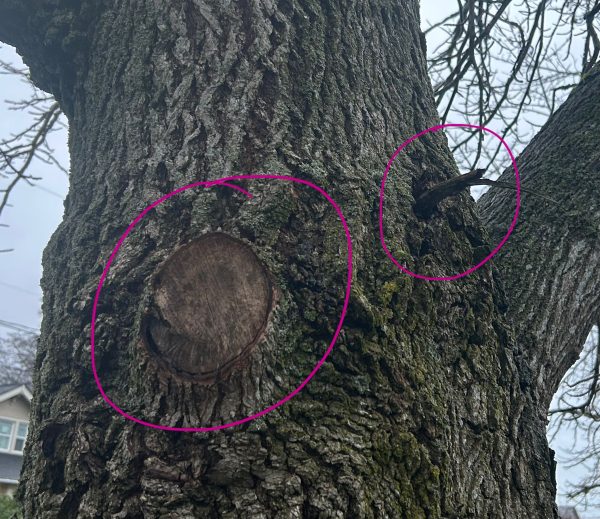
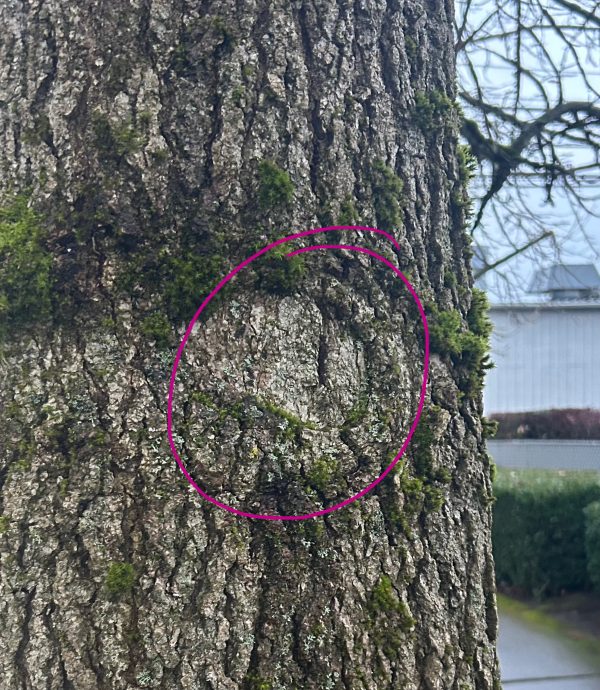
Knots are a bigger problem when cutting logs, branches, or firewood, or cutting down trees. Look for places where branches are attached, or where there was a branch in the past, even long ago. These places will have knots. Large branches (thicker than your thumb) create large knots that can cause problems.
 |
 |
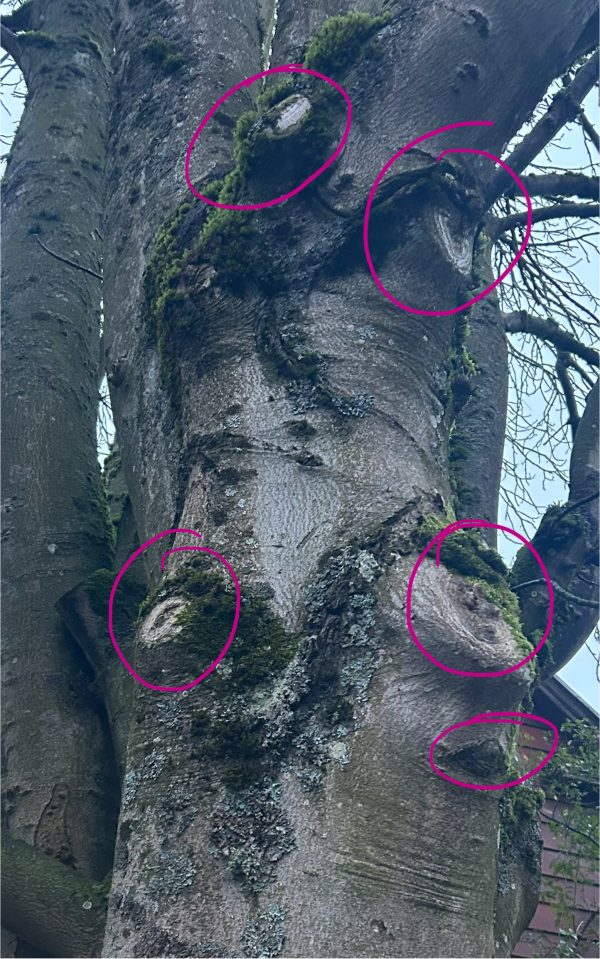 |
| These photos show the places on living tree trunks where there used to be branches. These places will have knots in the wood when you cut it. | ||
If you see large knots in your lumber or wood, cut around them, or use different wood.
Prepare the work area
Chain saws and pole saws are dangerous. You must make sure no other people or pets come near you while you are using it, especially children. You also need to make sure you will be safe while using it.
- Keep children and pets far away from the saw and from the area where you are working. If possible, keep them inside the house.
- If you are cutting down branches that are above head height with a pole saw, block off a large area underneath the branches. This prevents people from being hurt by falling branches. Use traffic cones or caution tape. You may need to have another adult stand outside with you to prevent other people from coming into the area.
- Check for power lines near where you will be working. Make sure any branches or trees you are cutting will not hit a power line.
- Make sure there is enough light in our work area so that you can see what you are doing. View the work lighting you can borrow from the TTL.
- Make it less likely that you will trip or stumble.
- Remove anything on the ground around where you will be working.
- Make sure your footing is stable and level. Don’t stand on a hillside or on slippery or muddy ground.
- Decide where the extension cord will run, and make sure you won’t trip over it (or accidentally cut it!)
- If you are cutting down a tree, plan an escape path (where you will move when the tree starts to fall). Make sure that path is clear with nothing in the way. Learn more about cutting down a tree (HomeDepot.com).
- Never use a chain saw while standing on a ladder. Instead, use a pole saw while standing on the ground, or hire a professional.
- Make sure the place where the saw is plugged into the extension cord does not get wet. Put it on top of something a few inches tall, like a brick or board or an upside-down bucket, instead of directly on the ground.
Put on your personal protective equipment
Don’t forget your eye protection, closed-toed shoes, long pants, hearing protection, long-sleeved shirt, and non-slip gloves!
Using the chain saw or pole saw
Check the saw before you start it
Look at the saw to make sure it is safe to use.
- If you used a key, wrench, or any other tool to adjust the saw, check to see that the key or wrench is removed and is not attached to the saw anymore.
- Make sure the power switch is in the OFF position before you plug the saw into the extension cord or insert its battery.
- Look at the oil inspection window. The oil level should be above the minimum mark.
- Check the chain tension. Hold the saw up and look at the bottom of the bar. The chain should not be sagging underneath the bar. It should be touching the bar at all points. But you should be able to turn it by hand. If it is sagging, it is too loose. If you cannot turn it by hand, it is too tight. If you need to adjust the chain tension, read your saw’s manual to learn how to do it.
How to hold a chain saw or pole saw
Put both your feet firmly on the ground. Never use a chain saw or pole saw while standing on surfaces that are uneven, unstable, or slippery.
Always hold the saw with both hands.
Be aware of the chain line. The chain line is the area directly behind the chain, in a straight line. This is where the chain will go if it breaks or if there is kickback. Never put your body in this area. Always hold the saw so that your body is to the side of the chain line.
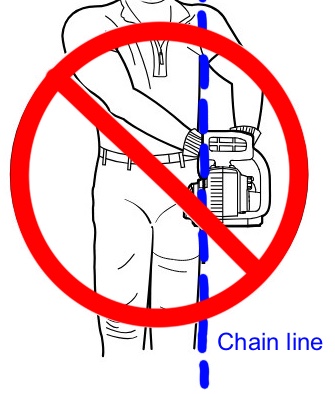 Never put your body directly behind the chain line.
Holding a chain saw
- Hold the chain saw at an angle, or to one side of your body. If there is kickback, you don’t want it to kick back right into your body or face.
- Always hold the front handle with your left hand and the back handle with your right hand. Your fingers should go around the handle, and your thumb should be below the front handle.
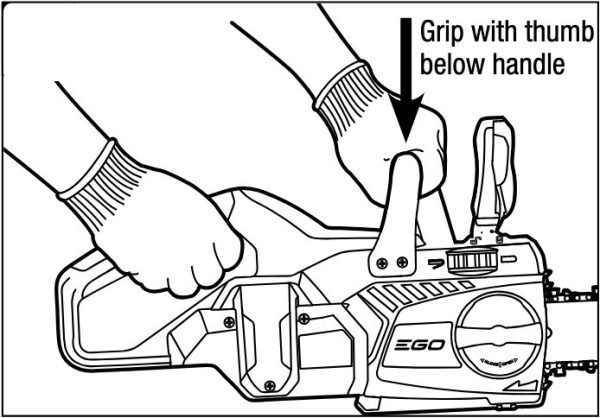 Hold the chain saw with your right hand on the rear handle and your left hand on the front handle.
Note: You must hold the chain saw this way even if you are left-handed. Do not hold the front handle with your right hand and the back handle with your left hand. This is a safety requirement. It keeps your body out of the way of the chain line, so that you are not in the way if there is kickback or the chain comes off. Never use a left-handed (cross-handed) grip, or any stance that places your body or arm across the chain line.
- Keep your left arm (holding the front handle) straight, not bent. This helps you keep your body out of the chain line.
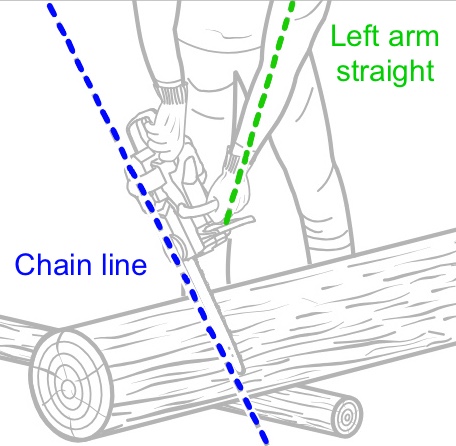 Keep your left arm straight to keep your body out of the chain line.
Holding a pole saw
- Stand to the side of the branch you are cutting, not directly below it.
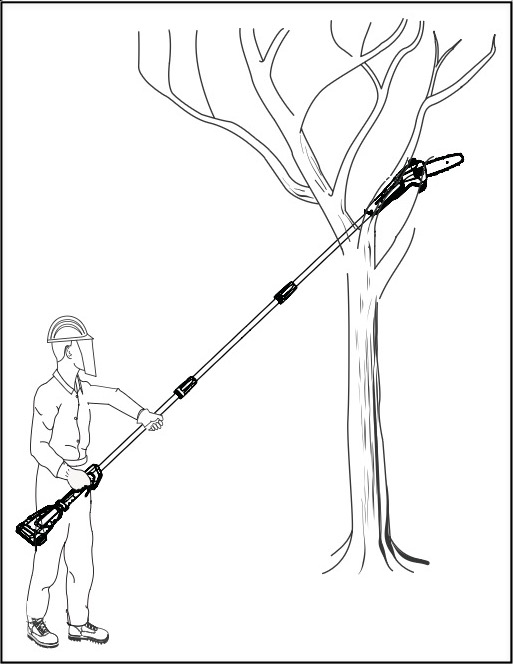
- Hold the saw firmly with both hands. Always keep your left hand on the pole and your right hand on the back handle, so your body is to the left of the chain line.
- Note: You must hold the pole saw this way even if you are left-handed. This is a safety requirement. It keeps your body out of the way of the chain line, so that you are not in the way if there is kickback or the chain comes off. Never use a left-handed (cross-handed) grip, or any stance that places your body or arm across the chain line.
Starting the saw
Electric pole saws and chain saws have a button or switch to turn them on. The start button or switch may be in a different place on different models of electric chain saw or pole saw. For details about any of the Tacoma Tool Library’s chain saws or pole saws, look up your chosen saw by its five-digit ID number in the TTL catalog to find a link to its manual.
For all models, you will follow these steps to start the saw:
- Follow the steps above under “Check the saw before you start it,” including checking the oil level and the chain tension.
- Insert the battery or plug the saw’s cord into the extension cord.
- Make sure there are no items near the bar. Do not rest the bar on any surface.
- Push the chain brake forward to engage it (turn it on), if you’re using a chain saw or a pole saw that has one.
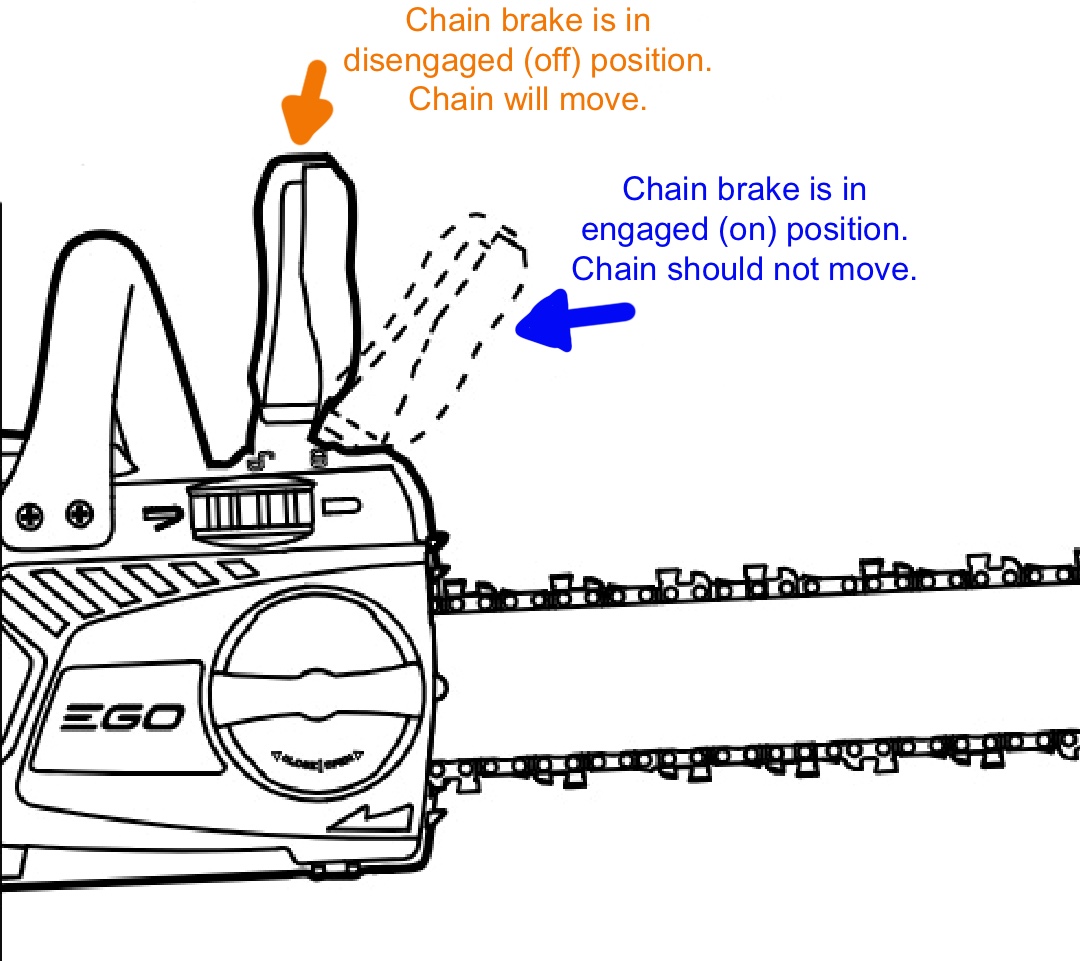 The chain brake is on (engaged) when the handle is pushed forward. The chain brake is off (disengaged) when the handle is pulled back.
 - Press the safety switch and pull the trigger at the same time.
- Push the chain brake forward (on), press the safety switch and trigger—the saw should NOT start. Pull the brake back (off), press the switch and trigger again—the chain should move. Push the brake forward again to verify it stops the chain immediately
- If the chain brain is on (forward), the saw should NOT start.
- Pull the chain brake backwards towards you to disengage it (turn it off).
- Again press the safety switch and pull the trigger at the same time.
- The saw’s motor will start, and the chain will start moving. The saw is now very dangerous.
- Push the chain brake forward again to make sure it works. The saw should stop immediately. If the chain does not stop moving when you push the chain brake forward, do not use the chain saw.
- Never start the chain saw when it is in contact with the wood. Always allow the chain saw reach full speed before making contact with the wood.
Cutting
Practice cutting a few small logs or branches to get the feel of using your saw before you begin the main part of your work.
With both chain saws and pole saws, start with these steps:
- Do not turn the saw on yet.
- Get in a comfortable, stable stance in front of the wood. Hold the saw properly as described above.
- Start the saw’s motor and chain according to the directions for your saw model.
- Wait for the chain to reach full speed before you start to cut.
Cutting with a chain saw
Basic cutting follows these simple steps.
- Follow the steps above to get ready.
- When the chain is running at full speed, lightly press the bar against the wood. Do not press hard. Let the saw do the work.
- Keep the same steady, light pressure while you are making the cut.
- When the saw has almost cut through the wood, ease up on the pressure. You want to stay in control of the saw when the wood separates, so the saw does not suddenly drop or fall forward.
- As soon as the wood is cut all the way through, let go of the trigger so the chain stops.
There are specific techniques and steps to take for different types of cutting, such as felling (cutting down) a tree or bucking (cutting logs into shorter pieces).
For example, you can find more information about felling a tree on page 31 of the manual for the Ego CS1600 chain saw (PDF) or on HomeDepot.com’s article titled “How to Cut Down a Tree.”
And for cutting logs into shorter pieces (bucking), you can learn techniques for bucking logs on page 33 of the manual for the Ego CS1600 chain saw (PDF) or from the University of Missouri Extension page about Felling, Limbing, and Bucking Trees, under the header “Bucking a tree.” Note that bucking is easier and safer if you use a stand called a sawbuck or bucking stand. The Tacoma Tool Library has a sawbuck you can borrow.
Cutting with a pole saw
Using a pole saw to remove branches that are above your head requires different techniques than when using a chain saw.
- Follow the steps above to get ready.
- When the chain is running at full speed, start by cutting from the bottom of the branch (making an undercut), near the tree’s trunk. Lightly press the top of the saw’s bar into the bottom of the branch. Cut approximately one-quarter to one-third of the way through the branch.
- Move the saw to the top of the branch to make a second cut. Lightly press the bottom of the saw’s blade into the top of the branch. This second cut should be farther from the trunk of the tree and closer to the end of the branch. Keep cutting until the branch falls. The weight of the branch will help the cutting process.
- When the branch falls, the pole saw’s weight will change in your hands. Be ready for this, so you do not stumble or drop the saw.
- Make one more cut close to the trunk to remove any jagged edges.
- As soon as the branch is cut all the way through, let go of the trigger so the chain stops.
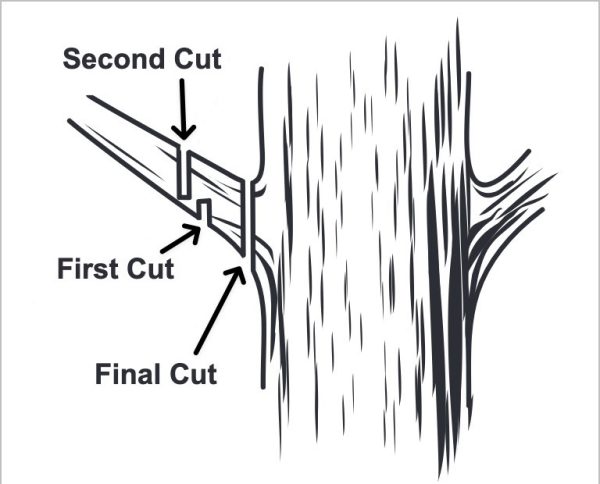
Watching the chain
While you are using the saw, pay attention to how it is working, especially the chain.
- The chain should rotate smoothly around the bar. If it stops rotating, let go of the trigger and turn off the saw. Do not try to force it.
- You should see small drops of oil coming off the chain when it moves. This means the chain is being lubricated properly. If you do not see oil coming off the chain, stop the saw and check the oil level. Follow the steps described below if you need to add bar and chain oil.
- The chain should never smoke. Stop the saw immediately if you see smoke. Smoke means the chain is overheating. This can happen if there is not enough oil, or if the chain’s tension is too tight.
- If cutting becomes slow or difficult, the chain may be dull. Do not simply press harder! You could get injured. Stop using the saw. Bring it back to the Tacoma Tool Library and tell the librarians what happened so we can fix it.
Stopping the saw
Never stop the saw while it is still in the wood. Move the saw away from the cutting area first.
To stop the saw’s motor, let go of the trigger. Push the chain brake handle forward (if it has one) to stop the chain from rotating.
Most electric chain saws and pole saws slow down and stop gradually, not immediately. Be careful with the saw until the motor has stopped completely.
Remove the battery or unplug the saw, even if you are just taking a break. This prevents accidents.
Safety issues that can happen during cutting
Kickback
Kickback is when the saw moves backwards suddenly, towards your body. This is very dangerous and can cause serious injury.
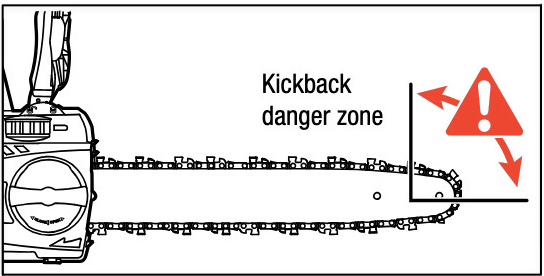 The tip of the bar is the kickback zone or the kickback danger zone. Always be very careful to make sure this area doesn’t come into contact with any objects while the saw is running.
The tip of the bar is called the “kickback zone” or “kickback danger zone.” Kickback can happen if the tip of the bar touches or hits an object while the saw is running (rotational kickback), or if the tip of the bar gets pinched in the cut while the saw is running (linear kickback).
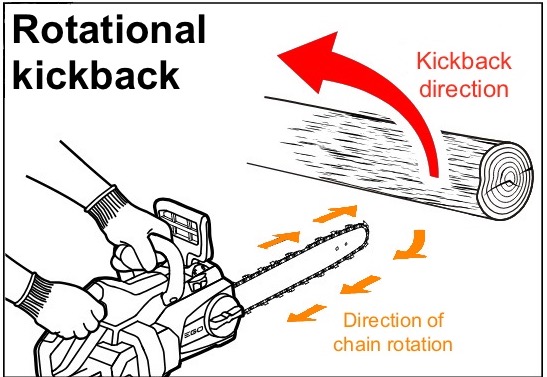 Rotational kickback happens when the tip of the bar comes into contact with something.
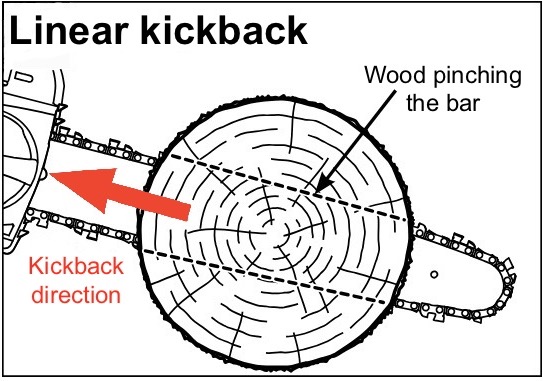 Linear kickback happens when the wood you are cutting pinches the bar and chain, and stops the chain from rotating.
Always read your saw’s manual for more information and safety tips.
Binding / Pinching
Binding (also called pinching) is when the wood traps the bar and chain while you are cutting and makes the chain stop moving. This can damage the saw or cause kickback.
The chain can get stuck (bound) when the weight of the wood shifts while you are cutting it. It can happen when you are cutting logs or lumber with a chain saw, or if you are cutting off a branch with a pole saw.
If the chain gets stuck (bound):
- Let go of the trigger immediately to turn off the saw.
- Do not try to pull the saw out of the wood while the motor is running.
- When the motor has stopped completely, unplug the saw from the extension cord or remove its battery.
- Carefully remove the bar from the wood. Wear thick gloves.
- You may need to use something to wedge open the cut, to make it wider so you can remove the bar.
Cutting through
When you finish making a cut, the saw will come out the other side of the wood. Be ready for the saw to drop suddenly or move forward. If you do not prepare, this can make you lose your balance or lose control of the saw.
- Ease up on the pressure of the saw when the cut is almost done.
- Keep a firm grip on the saw with both hands. See above under “How to hold a chain saw or pole saw” for more information on correct grip and stance.
- Be ready for the saw’s weight to shift in your hands when the cut is completed.
- Let go of the trigger as soon as the cut is completed.
Oiling the saw
All chain saws and pole saws must be lubricated often with bar and chain oil while they are being used. Using the saw without bar and chain oil, or using it when the oil level is below the minimum mark, will damage the saw.
Some models automatically lubricate themselves, but on other models, you must push a small button to release oil and lubricate the chain. Look up your chosen saw by its five-digit ID number in the TTL catalog to find a link to its manual and to learn whether you need to oil it or not.
When you borrow a saw from the Tacoma Tool Library, its oil tank will be filled. But if you are doing a lot of cutting, you might need to refill the tank while you have it. Every time you start or stop the saw, check its oil level in the oil window and make sure it is not near the minimum level.
Only use chain saw bar and chain oil (sometimes called “bar oil”). Never use any other kind of oil.
To refill the oil tank:
- Unplug the saw from the extension cord, or remove its battery pack.
- Put the saw on a flat surface with the oil tank cap facing upward.
- Use a rag to wipe debris and dirt off the oil tank cap and the area around it. If dirt falls in the tank, it can damage the saw.
- Remove the cap of the oil tank.
- Slowly and carefully pour the bar and chain oil into the tank. The tank may have a filter that makes the oil go in slowly. Make sure you pour slowly so oil does not overflow or spill onto the body of the saw.
- Use a rag to wipe off any oil that dripped or spilled.
- Put the cap back on tightly.
- Turn the saw upright. Look at the oil window and make sure it shows that the tank is now full.
Note: bar and chain oil is flammable and can catch fire easily. Oily rags can even catch fire on their own (spontaneously combust), because they release heat when they dry. Never leave oily rags in a pile or with other items on top of them; always lay them out flat to dry. To dispose of oily rags safely, soak them in water and let them dry flat, then throw them away. Read more about safely disposing of oily rags at ThisOldHouse.com.
Next steps
If you’re not a member of the Tacoma Tool Library yet, start by creating your membership.
Now you can go to the Tacoma Tool Library’s catalog to reserve a chain saw or a pole saw and any other supplies you need. When you pick up your tools up, you will need to read and agree to our chain saw and pole saw training. You can review that training ahead of time.
A real person wrote this article, not AI!

Tacoma Tool Library is funded by WA State Department of Ecology with funding from Washington’s Climate Commitment Act. The CCA supports Washington’s climate action efforts by putting cap-and-invest dollars to work reducing climate pollution, creating jobs, and improving public health. Information about the CCA is available at www.climate.wa.gov.