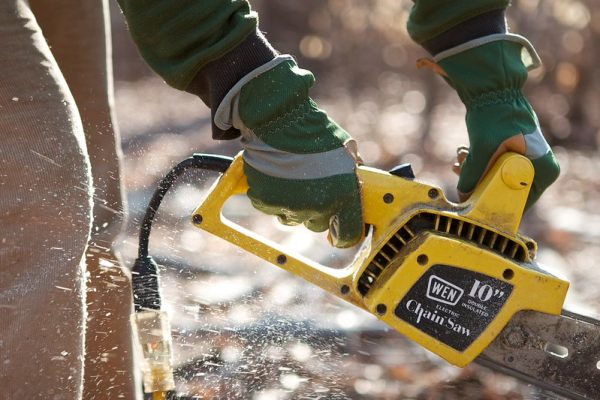
What are chain saws and pole saws?
Chain saws and pole saws are similar tools. They both have a motor, and a chain that has cutting teeth. The chain rotates around a long metal piece called a bar. The bar can come in different lengths. The length of the bar determines the width of the wood you can cut with it.
What is the difference between a chain saw and a pole saw?
The motor and the cutting part of chain saws and pole saws work the same way. But when you use chain saws and pole saws, you hold them in different ways, and you use them for different tasks. You hold a chain saw with your hands directly. A pole saw is a chain saw on a pole, and you hold the end of the pole. You can think of a pole saw as a small chain saw on a pole.
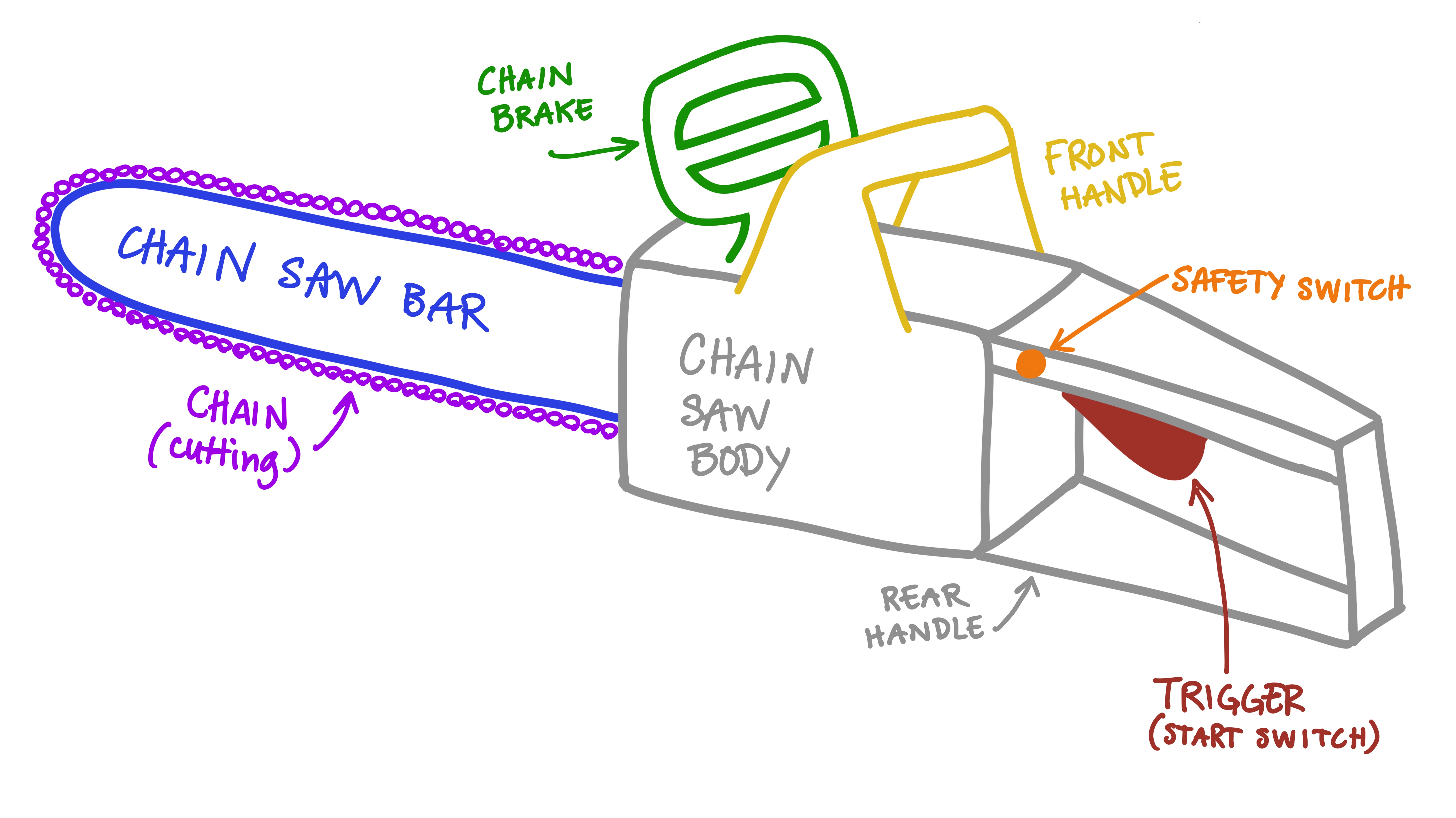 The parts of a generic chain saw The parts of a generic chain saw |
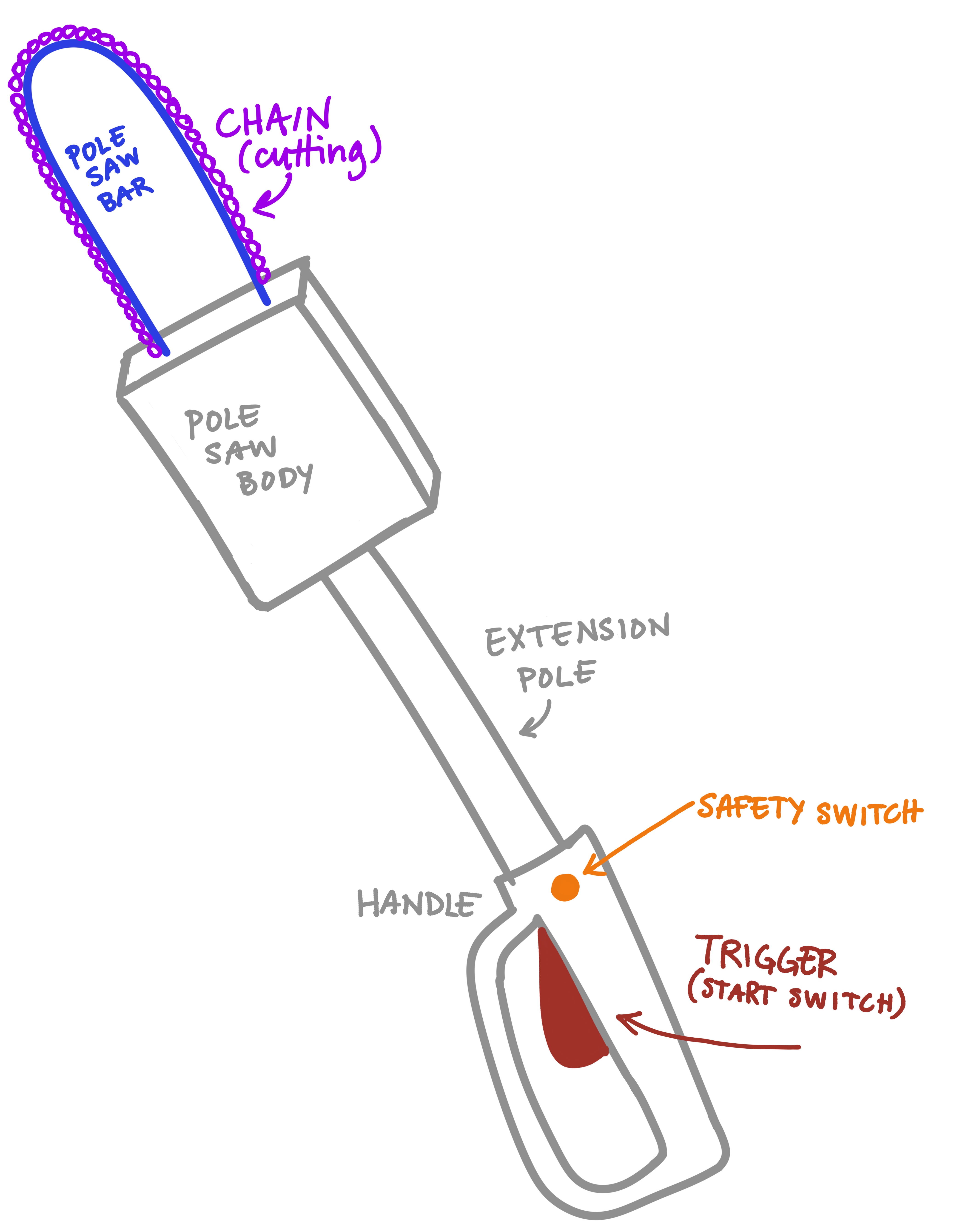 The parts of a generic pole saw The parts of a generic pole saw |
You use a chain saw for cutting wood that’s right in front of you. You can use it to cut down trees and to cut up trees or branches that are already down.
You use a pole saw to cut branches that are high above you, while you are standing on the ground. This is safer than using a chain saw while standing on a ladder.
Electric power vs gas power
All of the Tacoma Tool Library’s chain saws and pole saws are electric. They plug in to an electrical outlet or use a battery. They do not use gasoline.
Electric chain saws and pole saws work well for most things you need to do at home. But you need to understand the differences so you can choose the right tool for the job you need to do.
Gas chain saws and pole saws are more powerful, and they have faster cutting speeds. When you use a gas-powered saw, you don’t have to stop your work to charge a battery, and you don’t have to manage a long extension cord.
But gas chain saws and pole saws are heavier and louder than electric ones. Because they are burning gasoline, they create exhaust, which smells bad. Gas-powered saws also give off carbon monoxide, which can make you sick or even kill you if you breathe it in. You must always use a gas-powered saw or any other gas-powered item OUTSIDE, never inside or in an enclosed space. But electric chain saws and pole saws do not give off carbon monoxide, so it is safe to use them in enclosed areas like inside a garage.
Choosing which of the TTL’s chain saws or pole saws to use
The Tacoma Tool Library (TTL) has several chain saws and pole saws. They are different brands, and have different bar lengths and levels of power. Some use a battery and some plug in to an electrical outlet. For details about any of the TTL’s chain saws or pole saws, look up your chosen saw by its five-digit ID number in the TTL catalog to find a link to its manual.
When choosing a saw to use, you should think about:
- The type of job, including the location of the wood and how you can access it
- Whether there is an electrical outlet near your work area
- The size of the wood you need to cut
Chain saw or pole saw?
If you need to cut branches that are above your head, you should use a pole saw. The long pole lets you reach high branches without having to get on a ladder, which can be dangerous. It is safer to use a pole saw while standing on the ground than it is to use a chain saw while standing on a ladder.
If the wood you need to cut is already down on the ground, or if you want to cut down a tree, you should use a chain saw.
Battery or corded?
If there is no electrical outlet near your work area, you will need to use a battery-powered chain saw.
If you have a lot of wood to cut, a corded saw might be better than a battery-powered saw. The batteries run down while you’re using the saw, so you have to stop working to charge them. But if you are using a saw plugged into an electrical outlet, you will have a consistent power supply the whole time you are working.
If you use a saw with an extension cord, make sure you don’t trip over the cord or accidentally cut it with the saw!
| Benefits (Pros) | Drawbacks (Cons) | |
|---|---|---|
| Battery-powered |
|
|
| Corded |
|
|
Bar length
The bar is the long metal piece that sticks out in the front of the saw. The chain with cutting teeth rotates around the bar. This is what cuts the wood when you use a chain saw or a pole saw.
Bars come in different sizes, and the length of the bar determines the width of the wood you can cut with it. You need to use a saw that has a bar that is longer than the wood you need to cut. “For instance, if you think you’ll be cutting wood of up to 18” in diameter, you should choose a 20” chainsaw” (from TroyBilt.com).
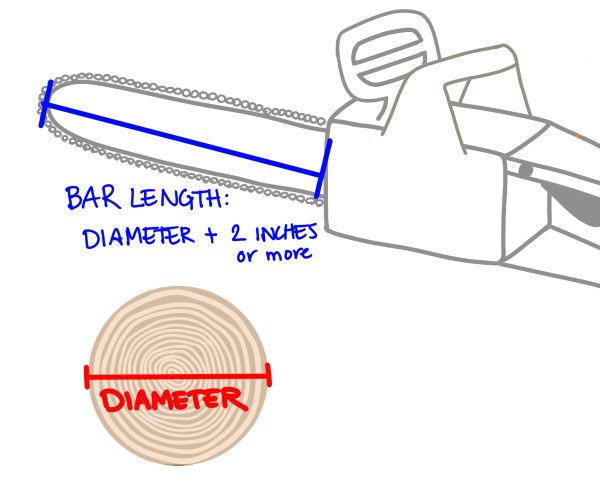 The length of the saw’s bar must always be longer than the width of the wood you are cutting.
Weight of the tool
Chain saws and pole saws can be heavy. Check the weight of the tool you’re considering, and make sure you can use it safely and comfortably.
Safety
Chain saws and pole saws are dangerous tools. You should always read the manual and follow the directions to use them safely and correctly.
Examine and prepare the wood
Before you start cutting, examine the wood.
Remove any metal
Look for any metal in the wood, like nails, screws, staples, or wire. If you hit metal with the saw, it could damage or break the chain. This could cause flying debris that could hurt you or any other people standing nearby. It could also cause the saw to kick back. Kickback is when the saw moves backwards suddenly, towards your body. Kickback is very dangerous.
Wood that has already been used to build something, like old fence wood, pallets, or other construction lumber, probably has metal in it.
If you find metal before you start cutting, you must remove it before you cut. If you can’t remove it, you must not use that wood. Cutting wood with metal in it will damage the saw and might hurt you.
If you accidentally cut into metal that you didn’t know was there, stop using the saw immediately. The chain is probably damaged. Bring the saw back to the Tacoma Tool Library and tell the librarians what happened so we can fix it.
Look for large knots in the wood
A knot grows in the wood where a branch comes out of the main trunk of a tree. The wood in a knot is much harder than the rest of the wood. If you cut through a large knot, the saw can bind (get stuck) or kick back (make the saw move backwards suddenly, towards your body). Both of these situations can be dangerous.
If the saw gets stuck or slows down when it hits a knot, stop. Cut around the knot instead. This is true for all types of wood.
Lumber from a store often has small knots, but these are not usually a problem. In lumber, knots look like circles or ovals that are darker than the rest of the wood.
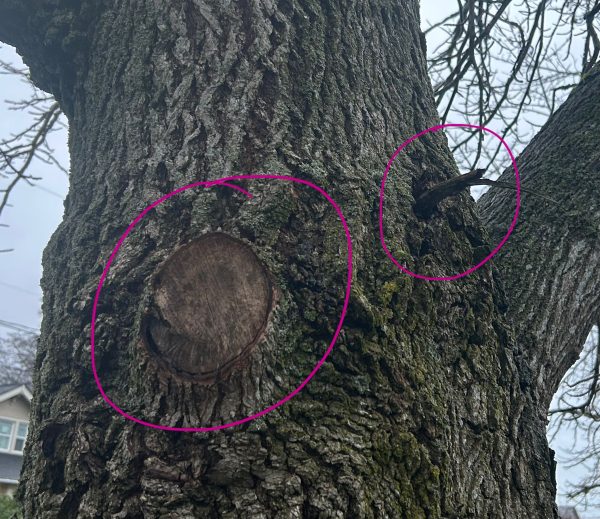
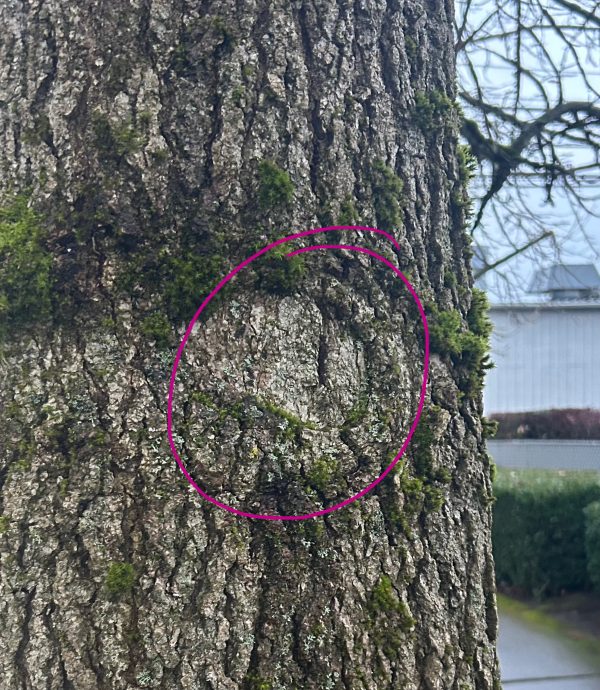
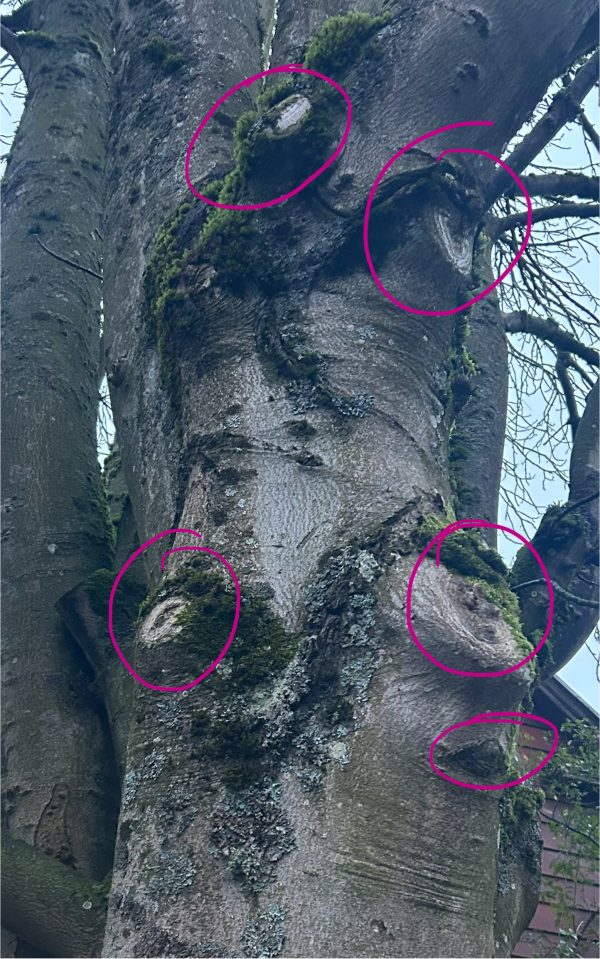
Knots are a bigger problem when cutting logs, branches, or firewood, or cutting down trees. Look for places where branches are attached, or where there was a branch in the past, even long ago. These places will have knots. Large branches (thicker than your thumb) create large knots that can cause problems.
 |
 |
 |
|
| These photos show the places on living tree trunks where there used to be branches. These places will have knots in the wood when you cut it. | |||
If you see large knots in your lumber or wood, cut around them, or use different wood.
Use personal protective equipment (PPE)
Always wear:
- Safety glasses or goggles — REQUIRED! View the safety goggles you can borrow from the TTL.
- Closed-toed shoes, not sandals — REQUIRED!
- Long pants made of a thick material.
- Hearing protection, like ear muffs. View the hearing protection you can borrow from the TTL.
You should also wear non-slip gloves and long-sleeved shirts to protect your hands and arms from splinters and flying debris.
Safety rules
- Keep all parts of your body away from the chain and bar while you are using the saw.
- Before you start the saw, make sure nothing is touching the chain and the bar.
- Keep children and pets far away from the saw and from the area where you are working. If possible, keep them inside the house.
- Never let children play with the saw.
- Make sure the saw can’t start accidentally:
- Make sure that the power switch is in the OFF position before you pick up the saw and before you plug it in to the extension cord or put the battery in.
- Remove the battery or unplug the extension cord when you are done working, before you carry or move the saw. Never carry the saw with the battery inserted.
- When you carry the saw, do not put your fingers near the trigger.
- Make sure the place where the saw is plugged into the extension cord does not get wet. Put it on top of something a few inches tall, like a brick or board or an upside-down bucket, instead of directly on the ground.
- Never operate a chain saw while standing on a ladder.
- Make sure your footing is stable.
- Make sure you are standing in a place where you can cut the wood without reaching or stretching too far.
- When using a chain saw, never try to make cuts above your shoulder height.
- When using a pole saw, never cut branches that are near or above power lines. If branches or debris fall on the power lines, it can cause a power outage or injure you.
- When using a pole saw, do not let anyone enter the work area under the tree or branch you are cutting.
- Avoid kickback. Kickback is when the saw moves backwards suddenly, towards your body. This is very dangerous and can cause serious injury.
- The tip of the bar is called the “kickback zone.” Kickback can happen if the tip of the bar touches or hits an object while the saw is running (rotational kickback), or if the tip of the bar gets pinched in the cut while the saw is running (linear kickback).
- Always read your saw’s manual for more information and safety tips.
Next steps
If you’re not a member of the Tacoma Tool Library yet, start by creating your membership.
Now you can go to the Tacoma Tool Library’s catalog to reserve a chain saw or a pole saw and any other supplies you need. When you pick up your tools up, you will need to read and agree to our chain saw/pole saw training. You can review that training ahead of time.
While you wait, read the second article in this series to get a step-by-step guide to setting up, using, and troubleshooting the chain saw or pole saw.
A real person wrote this article, not AI!

Tacoma Tool Library is funded by WA State Department of Ecology with funding from Washington’s Climate Commitment Act. The CCA supports Washington’s climate action efforts by putting cap-and-invest dollars to work reducing climate pollution, creating jobs, and improving public health. Information about the CCA is available at www.climate.wa.gov.